
Are you tired of searching for something on Google and still not getting exactly what you need? What if an artificial intelligence could help you meet your needs instantly? That’s the power of this AI prompt engineering guide, the ultimate shortcut to get your personalized answer and save your valuable time.
Why a Prompt Engineering Guide Matters
This prompt engineering guide is designed for beginners as well as professionals who want to get the most out of AI. From the Prompt Engineering guide, you will learn the language that can help you communicate with the AI using clear instructions so you get exactly what you need. This can help you save your precious time and get the most out of the AI plus it’s becoming a more valuable and in-demand skill of the present era.
A brief history & background
Prompt engineering isn’t a new concept. In the early days, people used to write code for computers to understand Human needs. However, writing code wasn’t that easy. It needed a precise knowledge of writing code, as a single misplaced character could crash the entire program, making the original form of prompt engineering rigid and unforgiving. As AI evolved, we shifted from computer language to having it understand our own. This is where modern Prompt Engineering was born. Now, people like me who don’t know how to code can get their work done easily by learning from Prompt Engineering Guide.

Core concepts of Prompt Engineering Guide
- Prompt: Think of giving instructions to a smart assistant, telling it what to do, who to be, and the rules to be followed. That is your prompt.
- Zero-Shot & Few-Shot Prompt: Sometimes you provide simple instructions to a smart assistant; this is called Zero-Shot prompting. Other times, you give a few examples, which is called Few-Shot prompting.
- Parameters: These are precise instructions you include in your prompt. They can be used to ask AI to be creative or stick to the facts, and set some limitations for the output.
Practical techniques in Prompt Engineering Guide
In this prompt engineering guide, these six simple techniques will help you write better prompts:
- Be Specific: To get the best output of an AI, you need to think like a director for an AI. Instead of being unclear, give it a clear and detailed script. For example, the prompt “Write about dogs” can be written as “Write a 300-word blog post about golden retrievers, written in a friendly tone, with three key tips for first-time owners.” Which can give you more accurate information about what you’re looking for.
- Use Examples: AI is like a newborn baby; sometimes, the best way is to show it directly what you want. This type is useful especially when you are looking for a specific format or style. For example, ” Convert 0° C to Fahrenheit” “Output: 32°F”. This kind of simple example can help you get consistent and accurate information.
- Break tasks into steps: For a complex task, don’t try to stuff everything in a single prompt. Rather than stuffing everything in a single prompt, you can break it through into multiple steps. For example, you can ask AI for an outline of an article you wish to write, and then you can ask for any point that you find relatable to you. This method will prevent AI from getting overwhelmed and ensure the output at the average stage satisfies your needs.
- Chain Prompts: Chain Prompt is like teaching AI to do a task step by step, rather than jumping directly to an answer. For example, you need to solve a math problem to get an answer; instead of a direct answer, you should know the process of solving it. The process of solving is a chain prompt.
- Control formatting: Control format in prompt engineering is giving the AI a structure to follow to match your output. For example, you have a long text story and you just want to summarize it. You can ask the AI,” Summarize this story in a very brief way with 250 words.” This type of prompt will help AI provide you with information in the way you want to be presented.
- Test and refine: Testing and refining can help you get a better result because by playing with wording and phrases, you’ll be able to adjust the output according to you. You can try different prompts like ” Write me a joke on school,” or ” Help me write a joke on school. It should be funnier for students and both teachers, not hurting anyone’s feelings or intending to disrespect anyone.” Now you can see the difference between the results.
Examples you can copy today
Here are some templates or prompts you can use:
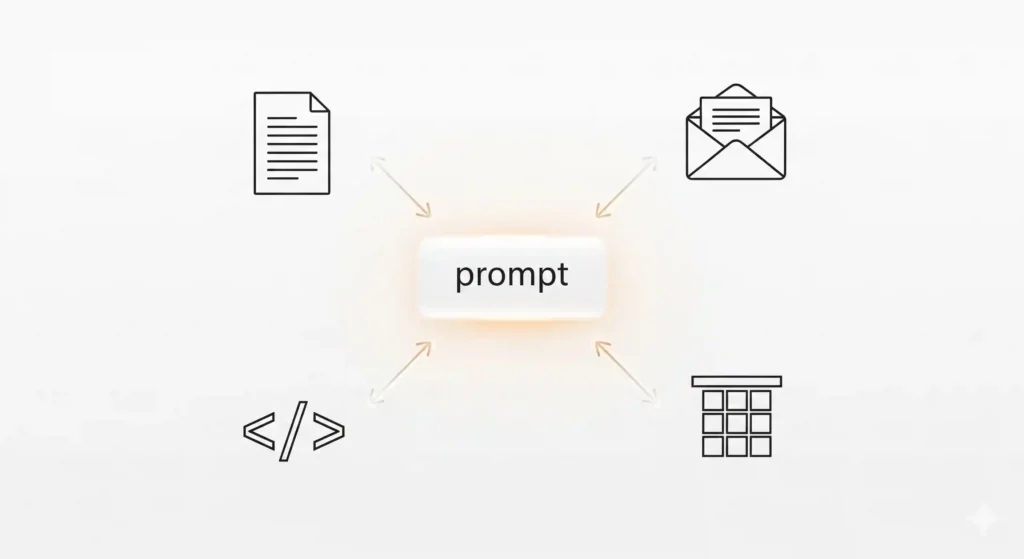
- Blog Outline: ” Take the role of an expert blog writer. Write me an outline of a blog with complete research to stand out from the article. Create a detailed outline for the article with headings like H1 and H2 for a minimum of 1500 words for the article on the [topic].”
- Professional Email: ” Write a polite email to the manager of [your company name]. Asking about a casual leave of 4 days in 150 words. Keep the email professional but warm.”
- Coding Task: Write a function [programming language] that [task]. Include comments to explain each step.
- Data extraction: Extract all [types of data] from the following text and present them in a [format example list table]: [text].
Common mistakes to avoid
AI is one of the most powerful tools, but it is easy to stumble if you are not careful with the prompt. Firstly, if you’re not clear with your prompt engineering guide, then it’s a complete disaster for you. For an AI to give you what you want, you need to have a completely transparent, detailed prompt. Secondly, Many people using a prompt engineering guide make the mistake of asking too much in a single prompt. You need to start from a simple prompt, and then you build up from there. And finally, never take an AI response as truth. Always double-check the facts, especially when writing about important stuff.
Real-world uses
Prompt engineering is already transforming industries:
- Content Writing: SEO friendly Article, Ad Copy, Descriptions
- Customer service: Drafting support responses.
- Programming: Code snippets, debugging, documentation.
- Education: Study guides, summaries, practice questions.
- Generating Images: Realistic, 3d, Sketch, etc.
Quick-start checklist
- State the role: “You are a…”.
- Specify format, tone, and length.
- Give examples if needed.
- Break down complex tasks.
- Always verify facts.
FAQ’s
Q: Do I need to be technical?
A: No, not at all. You don’t require any technical knowledge for prompt engineering.
Q: Is prompt engineering only for ChatGPT?
A: No, it applies to every AI text model.
Q: How do I get more creative answers?
A: Be specific with your question and provide context to get your creative answer.
Q: Can prompt engineering replace training AI?
A: Prompt engineering can’t replace training, but it can make the training process more effective.
Conclusion
By following this prompt engineering guide, you’ll master the art of communicating with AI effectively. It’s about learning the language to talk to an AI. If you can explain to AI what your needs are, it can save you lots of your time and give you exactly what you want. Start with simple prompts, an experiment with different wording and phrases to get your desired reserve, and then you will understand why this skill is becoming so important around the globe.
strongest thc gummies online for maximum potency effects