

How AI understands prompts is one of the biggest reasons some people consistently get better answers. Ever typed the same kind of question into ChatGPT or Claude on two different days and gotten two completely different answers? That’s not the AI having an off day, it’s reading your words in a strict, almost mechanical way that has very little to do with how a person reads a sentence. Once you get how AI actually understands prompts, prompt engineering stops being guesswork and turns into a skill you can actually get better at. So let’s open the hood and look at what happens between hitting enter and getting a reply.
What’s Actually Happening When AI Reads Your Prompt
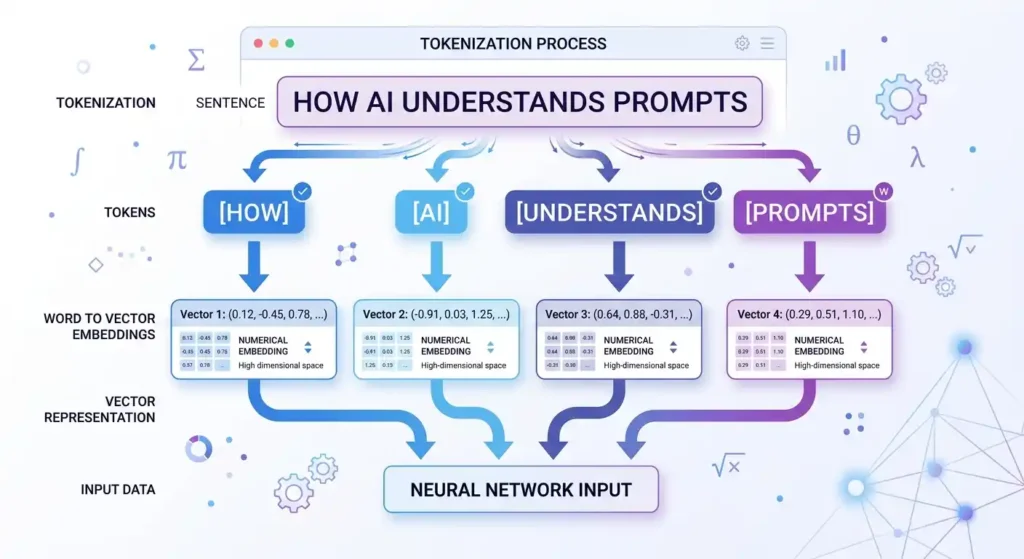
Before a model can respond to anything, it has to turn your words into something math can work with. Your sentence gets broken into small chunks called tokens, each token turns into a list of numbers called an embedding, and those numbers get run through layers that work out how the words relate to each other. Three steps, and it all happens in a blink. A token isn’t always a whole word, by the way, long or unusual words often get split into pieces, so “prompting” might come out as “prompt” and “ing,” two separate tokens.
I’ve always thought of this like a recipe. A cake recipe doesn’t understand “cake” as an idea, it just follows measured steps. Leave out an ingredient, or flip the order, and the result changes even though the recipe still technically “runs.” Your prompt works the same way: it’s the recipe, tokens are the ingredients, and the model’s internal layers are the steps turning those ingredients into whatever comes out the other side.
Which is really the whole point: the model isn’t reading for meaning the way you are, it’s finding patterns in numbers, so the way you phrase something directly shapes what you get back.
Why Wording and Order Change the Answer
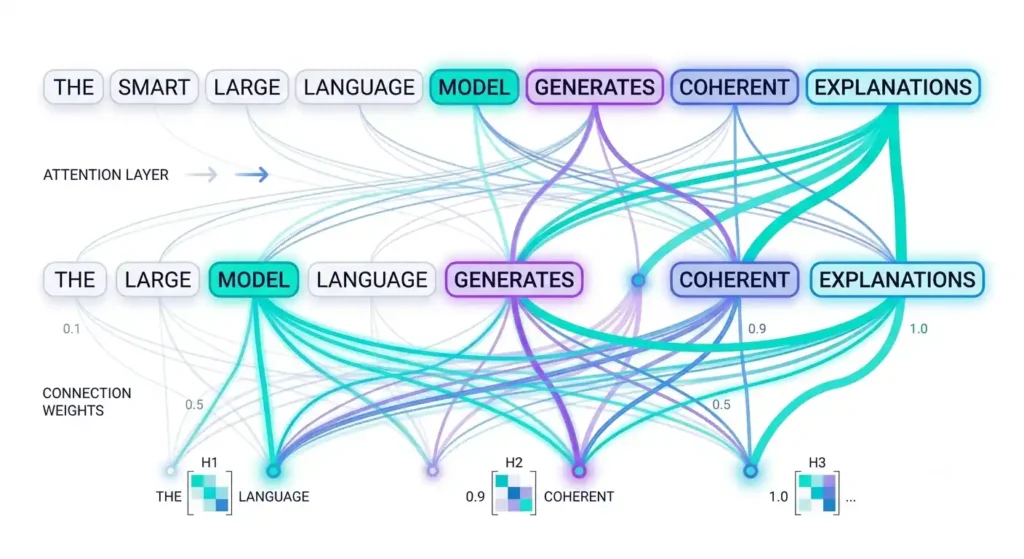
Once your prompt becomes tokens, the model leans on something called attention to figure out which words matter most to which other words. Put simply, attention is the model constantly asking “how relevant is this word to the one I’m working on right now,” and adjusting based on the answer. That’s exactly why a vague prompt gets you a vague answer, there’s nothing specific for the model to latch onto.
Small wording changes shift what the model pays attention to more than people expect. I’ve tested this enough times to know that two prompts which look almost identical on the surface can produce wildly different results, and it’s rarely random.
Take this pair:
- Skip this: “Write code to process the data.”
- Try this instead: “You’re a Python developer working with pandas. Write a function that reads a CSV of sales data and returns a summary of monthly totals.”
The first version gives the model almost nothing to grab onto, so it might hand you Python, JavaScript, or pseudocode, and it has no clue what “the data” even looks like. The second hands over specific words, Python, pandas, CSV, that pull its attention toward one answer instead of ten possible ones.
It’s a bit like giving directions to a cab driver who’s never been to your city before. The more specific landmarks you give, the less chance they take a wrong turn. Skip the landmarks, and even a great driver ends up guessing.
The Core Elements of a Prompt That Actually Works
Once you know how AI understands prompts through tokens and attention rather than actual understanding, you can write around that instead of hoping for the best. A handful of things show up in almost every prompt that works on the first try, and skipping even one of them usually means you’re rewriting it anyway:
- Clear instructions. Say exactly what you want the output to do, not just the topic. Skip: “tell me about this.” Try instead: “Summarize this in three bullet points.” The second version actually gives the model a format to aim for.
- Context. Tell it who the reader is, or what the content is for, so it isn’t guessing at the audience.
- Constraints. Set some kind of limit, length, tone, format, so the model isn’t picking between a hundred equally valid answers.
- Examples. Show it one or two samples of what you want. Researchers call this few-shot prompting, but really it’s just “here’s what good looks like.”
- Giving it a role helps too. Tell it to act as a senior copywriter, or a data analyst, or whatever fits, and it reaches for the vocabulary and structure that role would actually use.
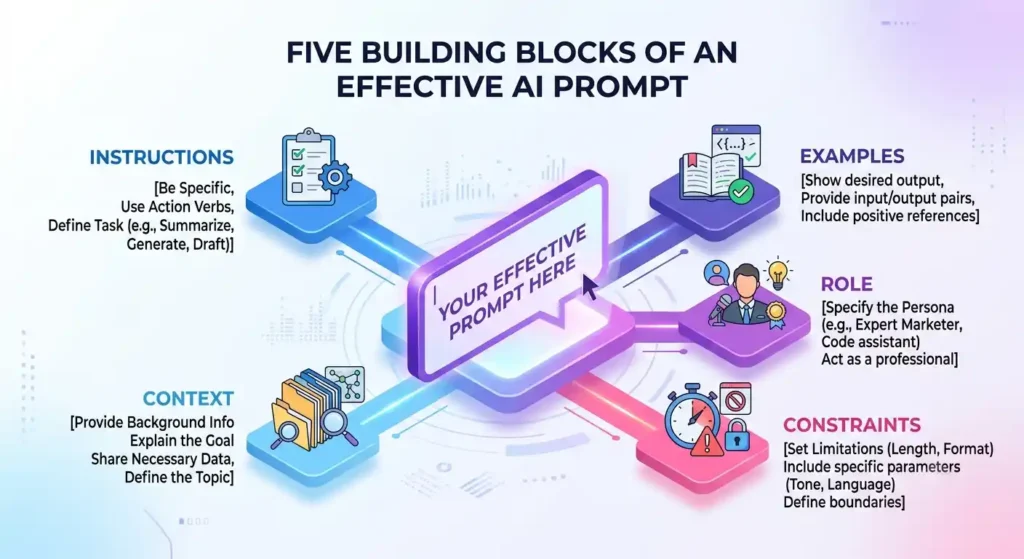
All five are doing the same job, really: giving the model’s attention something specific to grab onto instead of a blank canvas to guess at.
Prompting Techniques Backed by Real Research
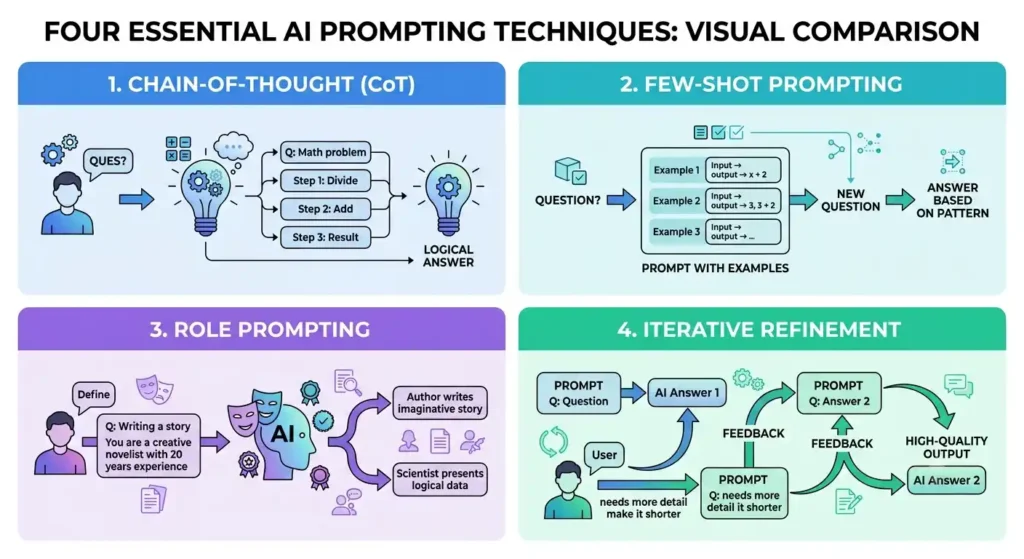
A few techniques come up again and again in research on how models reason through prompts. None of them need special tools, just a different way of structuring what you type:
- Chain-of-thought prompting. Ask the model to reason step by step instead of jumping straight to an answer. It works because the model builds context gradually instead of guessing the whole thing in one leap.
- Few-shot prompting. Give two or three input-and-output examples before your real question. The model uses them the way a baby picks up a pattern from repetition, by noticing what stays consistent across each one.
- Role prompting. Assign a persona before your instructions. It nudges the model’s attention toward the vocabulary that persona would use.
- Iterative refinement. Treat your first prompt like a rough draft, not a final answer. Adjust based on what comes back instead of expecting perfection on attempt one.
Honestly, I’d rather see someone use just one of these well than try to cram all four into a single message. Stack too many techniques into one prompt and you can confuse a model about as easily as you’d confuse a person.
Does This Work the Same Way in ChatGPT, Claude, and Gemini?
Mostly. The underlying process, tokens, embeddings, attention, is broadly the same across every major model, since they’re all built on transformer architecture, which is really just the neural network design that handles the tokenizing and attention we just walked through. But every provider trains and tunes things a little differently, so a prompt that works beautifully in one tool might need a small tweak in another.
Think of it like driving directions that work in most cities but need adjusting in the one town with a weird one-way system. Same map, different local quirks. So if a prompt underperforms after switching tools, that’s not necessarily you doing something wrong, just test a few small wording changes until it clicks with that particular model.
Common Mistakes People Make When Prompting AI
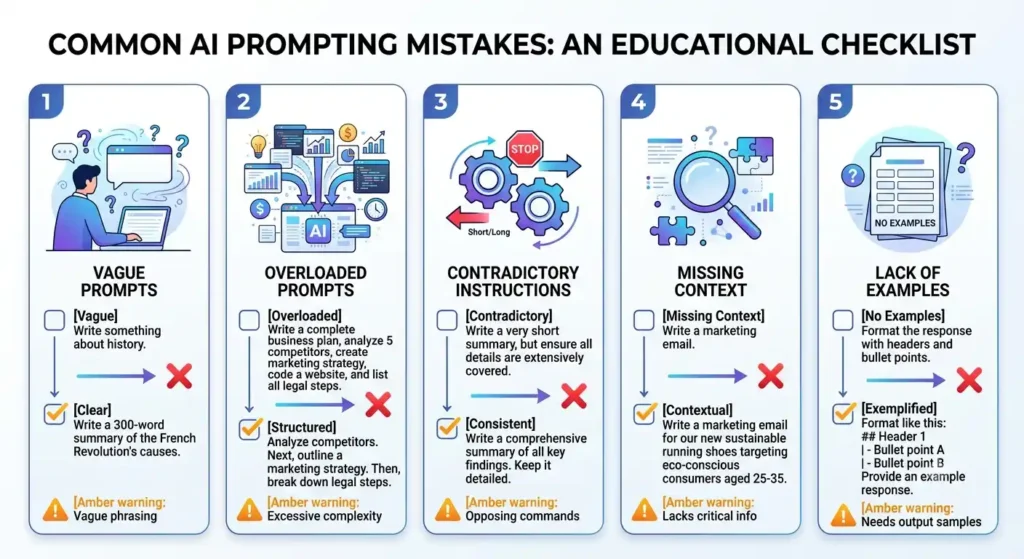
Even people who’ve been using these tools for months still repeat a handful of avoidable mistakes, and it’s rarely a beginner-only problem:
- Being too vague. Leaving out specifics and expecting the model to read your mind. “Make this better” tells it nothing, “make this 20% shorter and more formal” actually gives it something to act on.
- Overloading one prompt. Cramming five tasks into a single message splits the model’s attention across all of them instead of focusing it on one.
- Contradicting yourself. Asking for something “short but detailed” without noticing those two goals pull in opposite directions.
- Assuming it remembers everything. Expecting recall of details from ten messages back without repeating the key context.
- Skipping examples. Describing what you want in the abstract instead of just showing one sample.
Most of these come down to the same root problem, giving the model too little to work with, or too much all at once. Slow down, get specific about one thing, and most of it fixes itself.
Frequently Asked Questions
Does AI actually “understand” prompts the way a person does? Not really, no. It’s matching patterns in numbers based on everything it was trained on, it doesn’t have beliefs or awareness the way someone reading your message would. That said, the patterns are good enough that a well-written prompt consistently gets you something useful.
Why does the same prompt sometimes give different answers? Most models have a bit of built-in randomness on purpose, so you won’t get an identical response every time even with identical wording. Honestly, that’s a feature, not a bug, it keeps things from sounding robotic and repetitive.
Do longer prompts always work better? No, and this trips people up constantly. Pack a prompt with too many unrelated details and you bury the actual instruction. The goal is specific, not long.
What’s the fastest way to actually get better at this? Practice one prompt at a time, and rewrite it once based on what you get back. Treating your first draft as a starting point instead of a final version will teach you more about how AI understands prompts than any list of tips, including this one.
Conclusion
So next time an AI misses the mark, it’s not moody or having a bad day, it’s working with whatever tokens, context, and attention your prompt gave it. Prompt engineering isn’t some mysterious skill reserved for researchers, it’s learning to write directions clearly enough that a very literal system can actually follow them. Start small, take one prompt you already use, add a bit of context or one example, and see what changes. That habit alone, more than any trick, separates the people who fight with AI tools from the people who just get what they need.

 TechPro Master
[…] most of us were never taught how to give it enough to work with. That’s the whole idea behind prompt engineering with ChatGPT: learning how to talk to the model so it actually understands the result you’re […]