
You probably have heard about the term AI agent, and everyone is running to build one. At the beginning, I was also confused about what an AI agent was. I assumed it might be someone who is linked with an AI, but things took turns and started making some sense. I came to know that these agents are a part of artificial intelligence that are specified for a particular job. So, what is an How they work, and how to build them Will be learning all this information in this article. And who knows, you could be one of the AI agent creators.

So, What Exactly Is an AI Agent?
So what is an AI agent? In simple terms, it is software that aligns with artificial intelligence and works on its own; it doesn’t act like an artificial intelligence where a user asks a question and the AI responds to it. It’s completely different. So yeah, it does take your instructions, does every necessary action that is needed, and comes up with the complete task using all the resources the agent can, from API to using some tools, reading files, creating or modifying some code. Usually, an AI agent is created so that a user is not engaged with the AI on a regular basis. The agent does everything for the user.
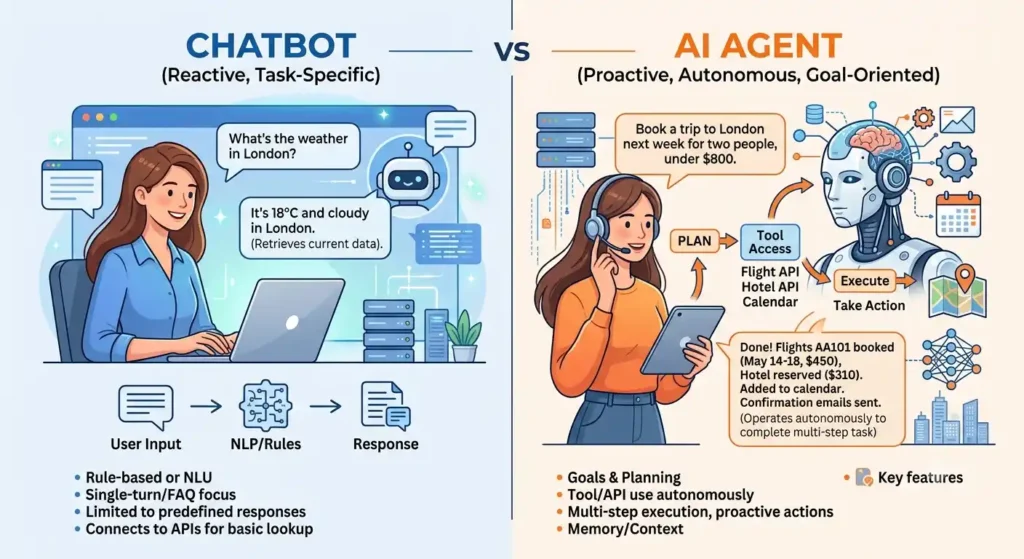
AI agent vs Chatbot
Here is an example to help you better understand the term AI agent. AI agent vs Chatbot are two different categories Speaking of chatbot it acts a Co worker who usually talks when you to them first whereas an AI agent is someone who is likely to be a person you hire to do a job you give them a with objective and they figure out how to do it unless they come to a dead end where they need your supervision. This is the major difference between an AI agent and a chatbot.
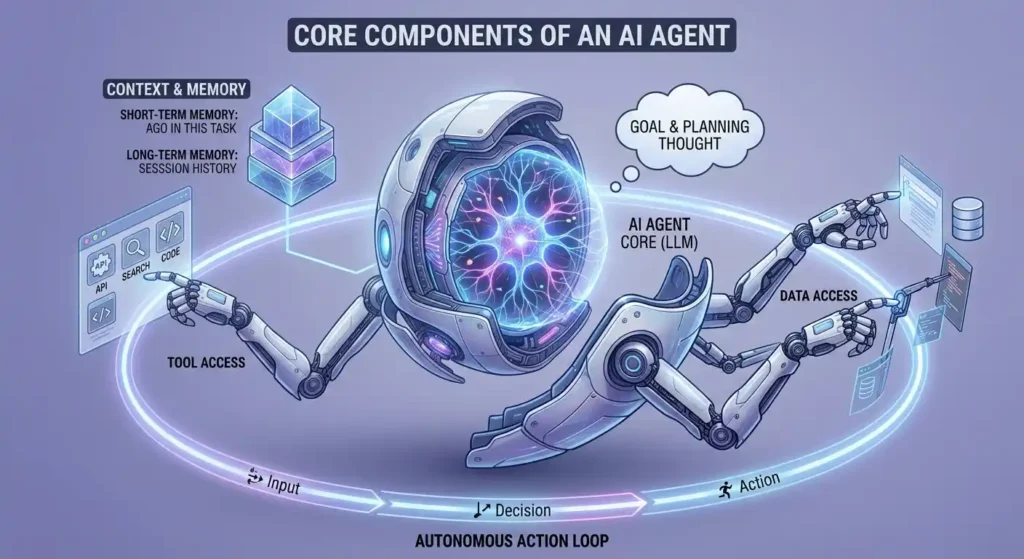
What’s Actually Going On Under the Hood
If you pick an AI and break them You will find a large language model doing the thought process of the AI agent, which is a similar kind of thought use behind ChatGPT or Claude. The thought process of an AI agent is the goal and figuring out what needs to happen. Basically, it’s the same model as ChatGPT and Claude, except it has been presented differently. The most basic thing here is the prompt, whereas a human could only write the basic prompt, but the prompts behind this AI agent are extremely detail oriented prompt Which is responsible for getting positive results out of it.
Then there’s planning. A vague goal like “launch this product” doesn’t mean anything to a computer on its own, so the planning piece breaks it into an actual sequence, research competitors, draft copy, schedule the announcement, whatever the steps happen to be.
Memory is the part people underestimate. Short-term memory is just what happened a second ago in this particular task. Long-term memory is what lets the thing remember something from three sessions back, the way a coworker remembers what you asked for last Tuesday instead of making you repeat the whole thing.
And tools are the hands. Search, an API call, a code interpreter, a database lookup. Without something to actually reach out and touch, you don’t have an agent, you have a chatbot that’s very good at describing what it would do if it could.
One execution loop ties all of it together, cycling through watching what’s happening, deciding what to do about it, doing it, and checking again, on repeat, until the goal’s actually met or the thing realizes it’s stuck.
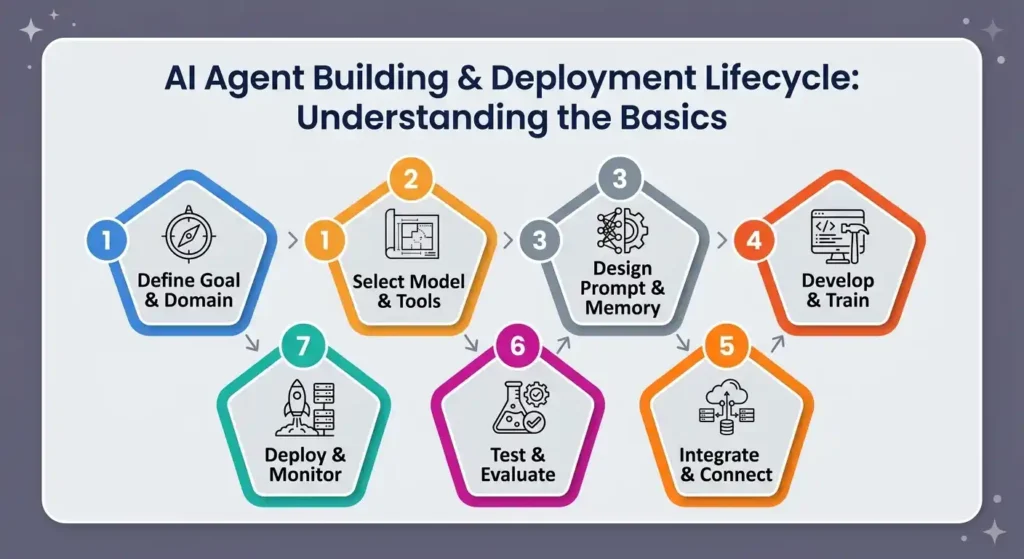
How This Plays Out in Practice
When you ask an AI agent to fix an issue, it starts looking for the error messages and then starts searching for whatever file seems relevant. After searching and analyzing the files that are relevant to the issue, it gives an output of what could be wrong in those files and tries to correct it, and the agent can run and test it by itself on a virtual machine. After running all the test It does a recheck of whether every bug or issue has been fixed or not, only after it decides what to do next.
Let’s understand this cycle with an example. Think of it like giving an instruction to a cab driver where none of you have been. You just don’t give all the mapping directions at once. You give them the destination and let them adjust according to the traffic or road conditions.
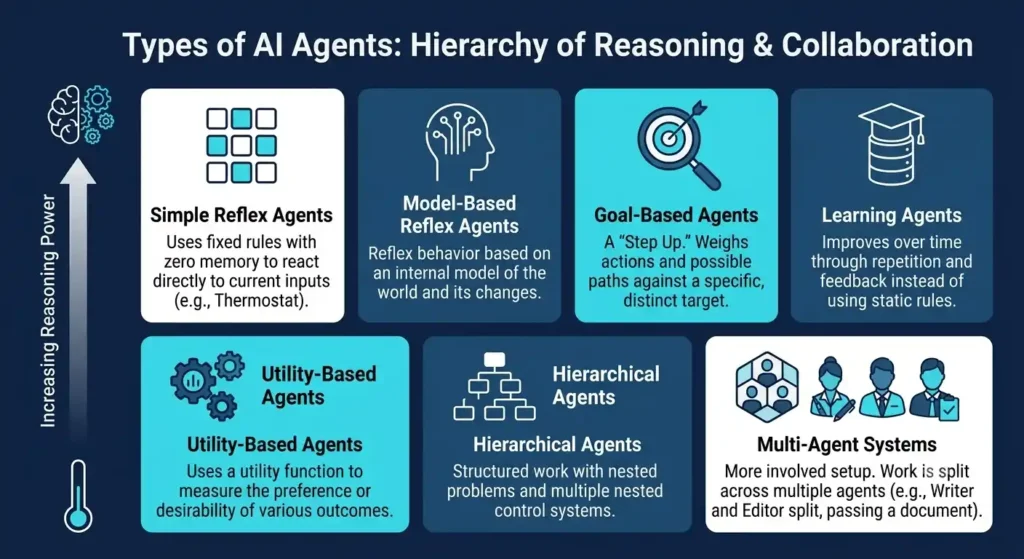
Types of AI Agents
Not every agent needs the same amount of reasoning power, and honestly that’s the real difference between the types. On the simple end you’ve got reflex agents. Fixed rules, zero memory, react to whatever’s directly in front of them, not much smarter than a thermostat clicking on when the room gets cold. A step up from there, goal-based agents actually weigh whether an action moves them toward a target before doing it.
Learning agents get better the more they run, picking up on what worked last time the way anyone gets better at something through repetition instead of just being handed a rulebook once. And then there’s the more involved setup, multi-agent systems, where the work gets split across several of these things instead of dumping it all on one. One drafts, another reviews, kind of like a writer and an editor passing the same document back and forth.
How to build an AI agent
This is usually the part people actually came here for. Good news, building one from scratch sounds a lot scarier than it is, mostly because you don’t have to build every piece yourself anymore. Most of the plumbing already exists in frameworks that were built for exactly this.
Roughly it goes like this. Pick a model to act as the reasoning core, Claude, GPT, something open source, doesn’t matter much for the basic version. Decide what tools it’s allowed to touch, a search function, a database, some internal API, and wire those up so the model can actually call them instead of just talking about calling them. Add a way to store memory so it’s not starting cold every single time. Give it a planning layer so it isn’t trying to solve the whole thing in one enormous leap. And then wrap all of that in a framework, LangChain’s LangGraph, CrewAI, Microsoft’s AutoGen, the OpenAI Agents SDK, something along those lines, so you’re not hand-writing the execution loop yourself from zero.
If it’s your first one, keep it small. A single-tool agent that does one job properly will teach you more about how this actually behaves than some ambitious five-agent setup will on day one. I say this because I tried the ambitious version first and spent more time debugging the coordination between agents than the actual task itself.
AI agent examples
None of this is theoretical anymore. Support teams run agents that close out tickets start to finish instead of just drafting something for a human to approve. Engineering teams have coding agents reading through a codebase, writing an actual fix, and opening the pull request without someone holding its hand the whole way. Sales teams use them for outreach that shifts depending on how a prospect responds, and ops teams lean on them to keep inventory and supply chains moving without a person babysitting every step of it.
Conclusion
That’s really the shape of it. Not a smarter chatbot, a system that takes a goal, plans its own route through it, uses tools to actually do something, and keeps adjusting until it’s done. Once you can spot that loop sitting under any product calling itself an agent, watch, think, act, check, the whole space stops feeling like a marketing term and starts making sense as an actual piece of technology. If you want to try it yourself, don’t overbuild. Pick one task, give it one tool, and just watch what happens.

 TechPro Master