
Ever typed a prompt into ChatGPT, gotten a decent answer, then had to copy that answer somewhere else, tweak it, and feed it back in for the next step? That back-and-forth is exactly what agentic AI is built to remove. Agentic AI is the shift from AI that answers you to AI that acts for you, planning out the steps and carrying them through mostly on its own. If you already know how to write a solid prompt, you’re closer to using agentic AI well than you might think, and this guide walks through what it actually is, how it differs from the AI you’re already using, and where prompting still fits into the picture.
What Is Agentic AI?
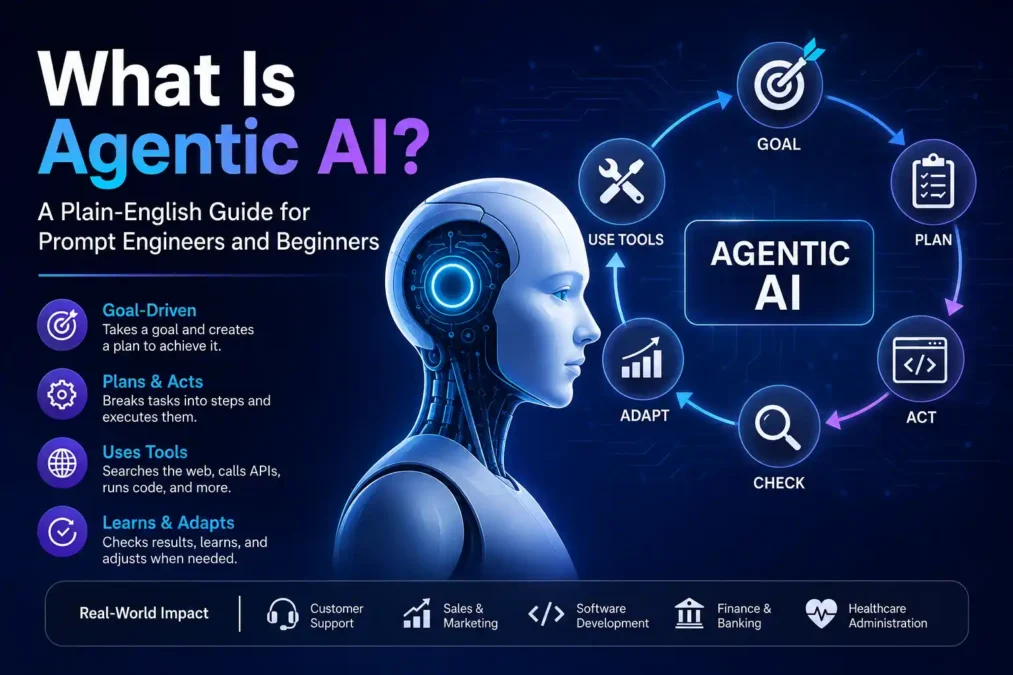
Agentic AI is a type of artificial intelligence that can take a goal, break it into steps, and carry out those steps with little or no hand-holding from a person. Instead of waiting for you to ask a follow-up question, an agentic AI system decides what the next step should be, based on what it just learned from the last one. It plans, it acts, it checks its own work against the goal, and it adjusts when something doesn’t go as expected, all without you typing a new prompt for every single move.
Here’s a quick way to picture it: a regular AI chatbot is like a friend giving you directions. They tell you turn left, then right, and after that, you’re on your own. Agentic AI is like a friend who gets behind the wheel and drives you there, and if there’s traffic on the planned route, they reroute without stopping to ask permission first.
Takeaway: agentic AI isn’t a smarter chatbot, it’s AI that’s been handed the steering wheel instead of just the map.
Agentic AI vs Generative AI: What’s Actually Different?
This is the comparison most people get tangled up in, so let’s untangle it. Generative AI (the kind behind most chatbots you’ve used) is reactive. You give it a prompt, it produces one output, and it stops. It doesn’t check whether that output actually solved your problem, and it won’t take a second action unless you ask it to. Salesforce sums up the core split well: generative AI reacts, agentic AI acts on its own, and that one distinction explains almost everything else that follows.
Agentic AI, on the other hand, keeps going. It holds onto context across multiple steps, decides what tool or resource it needs next, and only stops once the goal is actually met, or once it hits a wall it can’t solve alone. Unlike older rule-based software or a plain chatbot that needs a new prompt for every step, AWS describes agentic AI as proactive by nature, built to carry out complex, multi-step tasks without someone watching over every move.
| Generative AI | Agentic AI | |
|---|---|---|
| Behavior | Reactive, waits for a prompt | Proactive, pursues a goal |
| Output | One response per prompt | A sequence of actions |
| Memory | Usually limited to one conversation | Tracks progress across steps |
| Tools | Rarely uses outside tools on its own | Calls APIs, runs code, searches the web |
| Best for | Writing, summarizing, brainstorming | Multi-step tasks, workflows, research |
I’ve found the easiest way to remember it: generative AI produces something, agentic AI accomplishes something.
How Does Agentic AI Work? Core Elements of Agentic AI Systems
Underneath the term “agentic AI” is a handful of working parts, and understanding them makes the whole idea a lot less mysterious.
- Goal and planning: the system takes a broad instruction (“organize my inbox by priority”) and breaks it into smaller, ordered steps it can actually execute.
- Memory: it keeps track of what it already tried and what it learned, so it doesn’t repeat itself or lose the thread halfway through a long task.
- Tool use: it can reach outside the conversation to search the web, call an API, run code, or read a file, instead of just generating text about what it would do.
- Action and execution: it actually performs the step, not just describes it, and this is the part that separates agentic AI from a regular chatbot most clearly.
- Feedback and self-correction: it checks the result against the original goal and, if something’s off, tries a different approach instead of stopping.
As IBM puts it, agentic AI is built from AI agents, machine learning models that mimic human decision-making to solve problems in real time, and depending on the task, an agentic system might use one agent or several working together, each handling a narrower piece of the job.
Real-World Agentic AI Examples Across Industries
Reading a definition only gets you so far, so here’s where agentic AI actually shows up in day-to-day work right now.
- Customer support: an agent notices a customer’s billing issue, opens a support case, and drafts a resolution email without a human starting the process.
- Sales and pipeline management: an agent reviews prospect activity, flags the leads most likely to convert, and schedules follow-ups on its own.
- Software development: coding agents like Claude Code or Cursor read through an entire codebase, make multi-file edits, run tests, and fix what breaks, looping through that cycle without a developer typing each command.
- Finance and banking: an agent monitors transactions in real time, flags anomalies, and cross-checks them against compliance rules before a human ever sees the case.
- Healthcare administration: an agent handles scheduling, predicts bed occupancy, and manages routine paperwork so staff can focus on patients instead of forms.
Adoption is moving fast too. McKinsey projects that the tech services market tied to agentic AI could grow to between $1.6 trillion and $1.9 trillion by 2030, well ahead of earlier estimates from before agentic AI existed. That’s not a small shift, and it’s part of why understanding agentic AI now, rather than later, is worth your time.
Why Prompt Engineering Still Matters for Agentic AI
Here’s the part that matters most if you’ve spent time getting good at prompting: those skills don’t disappear with agentic AI, they just get applied differently. A single-turn prompt only has to carry you through one exchange. An agent’s instructions have to hold up across dozens of steps, tool calls, and decisions, so vague wording that a chatbot might quietly patch over will send an agent completely off course.
Bad example: “Book me a flight to Chicago.”
Better example: “You are a travel-booking assistant. Search for flights to Chicago departing next Tuesday after 3pm, prefer nonstop options under $400, and confirm with me before completing any purchase.”
The second version gives the agent a role, a constraint, a preference, and a stopping point, which is exactly what a multi-step system needs to act reliably instead of guessing. I’ve noticed agents fail on vague instructions far faster than chatbots do, mainly because there’s no natural follow-up question to catch the mistake before it happens.
This is really what people mean by “context engineering,” a close cousin of prompt engineering that’s more about designing the whole environment an agent operates in, not just the wording of a single request. Anthropic’s own engineering guidance on context goes deeper into how this works if you want to build on it.
Common Mistakes People Make When Starting with Agentic AI
- Giving an agent too much freedom too soon: start with a narrow, well-defined task before handing over an entire workflow.
- Skipping human checkpoints: for anything involving money, sensitive data, or outside communication, keep a review step in place, at least at first.
- Building one giant agent instead of a few focused ones: a system with several narrow specialists tends to outperform a single agent trying to do everything.
- Not logging what the agent actually did: without a record of each step, it’s nearly impossible to figure out where a task went wrong.
- Ignoring token and tool costs: agentic tasks can call tools and loop through steps repeatedly, so costs add up faster than a one-off chatbot reply.
Agentic AI FAQ
Is agentic AI the same thing as an AI agent? Not exactly. An AI agent is one component, a single model handling a task. Agentic AI describes the broader system or approach, which might involve several agents working together toward one goal.
Do I need to know how to code to use agentic AI? No, plenty of no-code and low-code agent platforms exist now, though building custom agentic workflows still benefits from some technical background.
Is agentic AI safe to use for business tasks? It can be, as long as guardrails are in place. Keep human review on anything high-stakes, and start with narrow, well-tested tasks before expanding an agent’s scope.
Will agentic AI replace prompt engineers? Unlikely any time soon. The skill shifts from writing one clever line to designing the rules, tools, and context an entire agent operates within, which is arguably a bigger job, not a smaller one.
Bringing It Together
Agentic AI isn’t a buzzword replacing the AI you already use, it’s the next layer built on top of it. Where generative AI answers, agentic AI acts, and where you used to write one prompt and read one answer, you’re now designing a system that plans, checks, and follows through on its own. The prompting instincts you’ve already built still count for a lot here, they just get pointed at a bigger target.
Start small: take one task you already prompt for regularly, and try turning it into a two- or three-step agent task instead. You’ll feel the difference immediately, and that’s the best way to get comfortable with where this is heading.

 TechPro Master