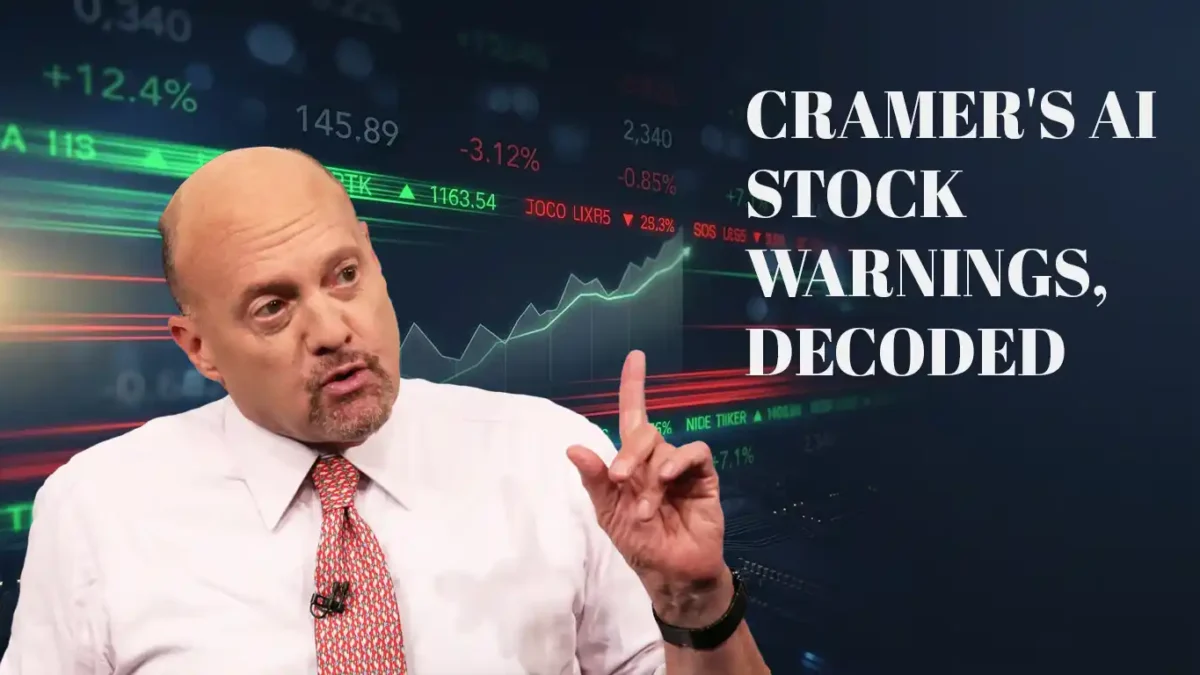

Jim Cramer AI stocks commentary has been everywhere this month, and if you’ve tried to follow all of it, you’ve probably walked away confused. One day he’s telling you AI froth fears are overblown. The next day he’s demanding hard proof that AI spending is actually paying off. So which is it? I went back through his last month of appearances, and it turns out both things are true at once, and once you see how they fit together, his whole approach makes a lot more sense.
Why Jim Cramer Thinks AI Stocks Froth Talk Is Overblown
On July 14, Cramer pushed back hard on comparisons to the dot-com crash. His argument wasn’t “there’s no froth anywhere.” It was that the froth sits in a small handful of outliers, not in the stocks most investors actually hold. He pointed to memory-chip makers like Micron and Sandisk, which have posted huge gains this year, and argued their valuations still look cheap relative to where earnings are heading in 2027.
Here’s the plain-English version of his point: a stock’s price doesn’t tell you much on its own. What matters is the price compared to what the company is expected to earn. Cramer noted the S&P 500 trades at roughly 20 times forward earnings today, versus more than 25 times heading into 2000. That’s not nothing, and it’s the number he leans on to say this isn’t the same setup as the dot-com bubble.
Think of it like buying a used car. A $30,000 car sounds expensive until you find out it’s basically new with low mileage, and a $10,000 car sounds cheap until you learn it needs a new engine. Price alone doesn’t tell you if something’s a good deal. You need to know what you’re actually getting for the money. That’s the lens Cramer’s using on AI stocks, and it’s why a stock jumping 600% this year doesn’t automatically mean “bubble” to him.
Takeaway: Cramer isn’t saying there’s zero froth. He’s saying the froth is concentrated in a few names, not spread across the whole market.
So why is he also demanding hard proof?
Just one day later, on July 15, Cramer sounded a lot more cautious. He said he needs “cold hard return facts,” meaning actual reported profits or cost savings tied to AI spending, and so far this earnings season, he isn’t hearing it. Banks were a particular letdown for him. He’d expected AI to obviously improve efficiency there, and instead he’s gotten a lot of vague talk and not much movement in the numbers that matter.
This isn’t a contradiction of his July 14 comments, even though it might look like one at first. He’s drawing a line between two different groups: the companies building AI infrastructure, like chipmakers, and the companies buying AI to use it, like banks and retailers. His view is that the builders are clearly making money right now. The buyers haven’t proven it yet. I’d put it this way: he’s optimistic about the shovel sellers and still waiting on evidence from everyone else.
Takeaway: “AI is real” and “AI is already paying off for every company using it” are two separate claims, and Cramer is only fully sold on the first one.
What’s his actual advice on the Magnificent Seven?
Back on July 9, Cramer tackled a different mistake he sees investors making: treating all seven of the biggest tech companies as one single trade. When Meta announced plans to build its own AI chips and expand its computing capacity, some investors sold the stock, reading the extra spending as a sign that costs have no ceiling.
Cramer’s take was the opposite. He argued that kind of spending usually means a company is looking at strong demand and building to meet it, not spending recklessly. His broader point: these seven companies have very different AI stories, different timelines, and different reasons for their stock moves, so lumping them together as one single trade misses what’s actually happening at each one.
A bad way to read this news would be: “Meta is spending more, so the stock should drop.” A better way to read it, by Cramer’s logic, would be: “Meta is spending more because it’s already seeing demand it needs to meet, so this could be a sign of confidence, not panic.” Same headline, two very different conclusions, and only one of them looks at why the spending is happening.
Takeaway: Don’t trade all seven Mag 7 stocks as a single basket. Cramer thinks each one deserves its own read.
Where’s he finding value away from the obvious plays?
Earlier in the month, on July 6, Cramer pointed away from the usual data-center darlings entirely and toward IBM, a stock most people don’t think of as an AI play at all. His reasoning came down to valuation again: IBM was trading at roughly 22 times forward earnings while many AI-adjacent names traded above 40 times, and its generative AI business had already crossed billions of dollars while mainframe revenue kept climbing.
I find this pick interesting mostly because of what it says about how Cramer hunts for opportunities. Instead of chasing the stock everyone’s already talking about, he’s looking for a company doing real AI business quietly, at a price that hasn’t caught up to the hype yet.
Takeaway: Sometimes the AI trade Cramer likes best is the one that doesn’t look like an AI trade on the surface.
What was his warning back in June?
Rewind further, to June 8, and you’ll find Cramer in a much more blunt mood. After a rough day for semiconductor stocks, he warned that any AI stock without accelerated earnings growth was, in his words, “pretty much done,” and that a stock could fall 50% and simply not come back for years.
This one ties everything else together. Cramer isn’t anti-froth-warning. He’s against price increases that aren’t backed by earnings increases. So the test he keeps coming back to, across every appearance, is simple: is the stock price growing faster than the company’s actual earnings, or the other way around? When price outruns earnings, he gets nervous. When earnings outrun price, he gets comfortable, even if the stock already looks expensive on the surface.
Common Mistakes When Reading Cramer’s AI Calls
- Treating one appearance as his whole view. Cramer’s comments build on each other over weeks. A single clip taken alone can look like a flat “bullish” or “bearish” call when it’s really one piece of a bigger argument.
- Confusing AI builders with AI buyers. His optimism about chipmakers and infrastructure companies doesn’t automatically extend to every company that says it’s “using AI.”
- Reading big spending announcements as automatically bad news. Cramer’s Meta example shows he often reads heavy spending as a sign of demand, not recklessness.
- Ignoring the valuation math behind his calls. Almost every one of his recent AI comments comes back to a specific number, like how many times forward earnings a stock trades at, not just a gut feeling about the market.
FAQ: Jim Cramer AI Stocks
Is Cramer bullish or bearish on AI stocks right now?
Neither, exactly. He’s bullish on AI infrastructure companies with reasonable valuations and earnings growth, and openly skeptical of companies that talk about AI without showing results.
What’s the one number he keeps coming back to?
Forward earnings multiples, basically how expensive a stock is compared to what the company is expected to earn next year.
Does he think this is another dot-com bubble?
No. He’s argued current valuations, interest rates, and corporate earnings all look meaningfully different from 2000.
Conclusion: Jim Cramer AI Stocks, in One Framework
So back to that original confusion: is Cramer worried about an AI bubble or not? The honest answer is that he’s worried about parts of it and confident about others, and the last month of his appearances actually lines up into one consistent framework once you read them together instead of as isolated headlines. If you’re trying to make sense of his next AI comment, start by asking which group he’s talking about, the builders or the buyers, and what the earnings math actually shows. That one habit will save you from misreading half of what he says.

 TechPro Master