

Trying to figure out whether to buy a phone right now or wait six weeks for something better is one of the most annoying decisions in tech. If you have been holding off on an upgrade because you kept hearing whispers about the Google Pixel 11 Pro, you are not imagining things. This phone has leaked more thoroughly than almost any Pixel before it, and Google itself has already confirmed a few of the biggest details. I have pulled together everything that is actually confirmed, everything that is still a leak, and what it all means for you, so you do not have to dig through a dozen tabs to make sense of it.
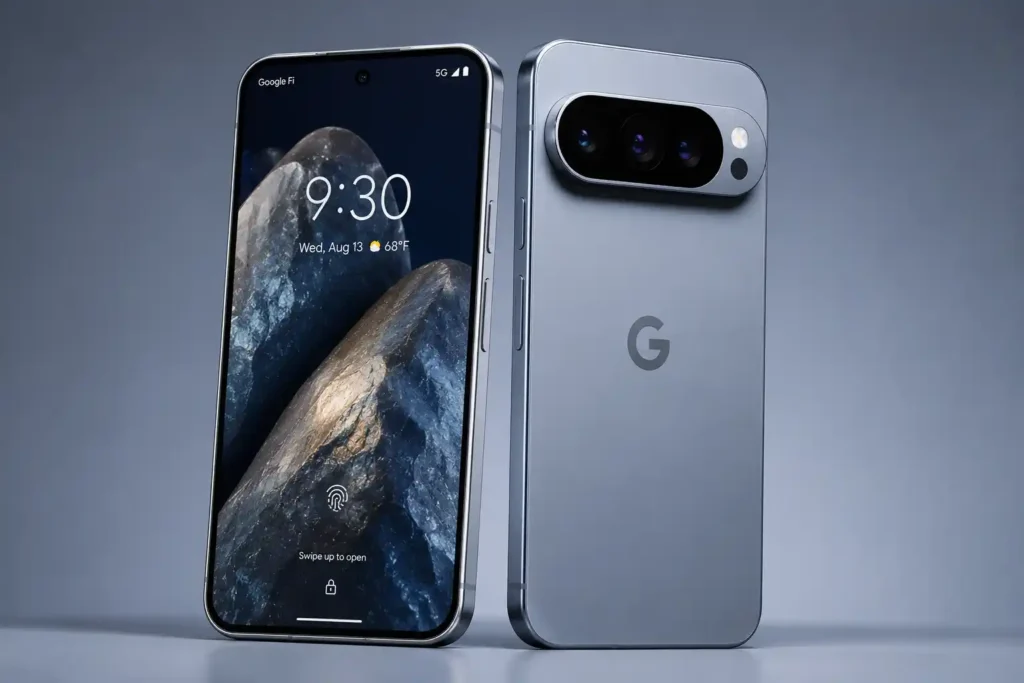
When Is the Google Pixel 11 Pro Glow Release Date?
Google has officially confirmed the Made by Google event for August 12, 2026, at 6 PM EDT (3 PM PDT) in New York City. That is one week earlier than last year’s Pixel 10 event, and it is where the Pixel 11 Pro, the standard Pixel 11, the Pixel 11 Pro XL, and the Pixel 11 Pro Fold are all expected to show up together. Wide availability is expected on August 20, 2026, with pre-orders likely opening the moment the event wraps.
Here is the plain-English version of what “release date” actually means here: the announcement is when Google shows the phone off on stage, and the release date is when you can actually walk into a store or check out and get one shipped to your door. Those are two different dates, and mixing them up is the easiest way to be disappointed on launch day. Think of it like a restaurant reservation versus the meal actually showing up at your table: the reservation is confirmed, but you still have to wait for the food.
Quick takeaway: the Pixel 11 Pro release date is locked at August 12 for the reveal and roughly August 20 for general availability, and both dates are about as solid as pre-launch information gets.
What Will the Google Pixel 11 Pro Price Actually Be?
This is where things get a little uncomfortable. Google has officially confirmed that Pixel 11 pricing will increase across the board, and the company has been surprisingly candid about why. Shakil Barkat, Google’s VP of Devices and Services, told 9to5Google that the cost of a single gigabyte of RAM jumped from around $2.80 to $12 in about a year, driven largely by AI data centers eating up the global memory chip supply. That is roughly a fourfold to sixfold increase, and Google says it can no longer absorb that cost the way it has in past years.
Leaked pricing (via a since-pulled Google Amazon listing) puts the numbers at:
- Pixel 11: $899 for 256GB, up from the Pixel 10’s $799 starting price
- Pixel 11 Pro: $1,099 for 256GB, up from $999
- Pixel 11 Pro XL: $1,299 for 256GB, up from $1,199
- Pixel 11 Pro Fold: $1,899 for 256GB, up from $1,799
So the google pixel 11 pro price looks like a straightforward $100 jump. But there is a twist worth knowing before you get annoyed at the number: base storage is reportedly doubling from 128GB to 256GB across the line, so you are getting more phone for that extra $100, not just the same phone at a higher cost. I would compare it to a coffee shop raising the price of a small coffee by a dollar but also making that “small” the size of what used to be a medium. It still stings a little, but it is not quite the same as a plain price hike.
Quick takeaway: expect roughly a $100 increase across the lineup, softened somewhat by doubled base storage, with official numbers confirmed on August 12.
The RAM Trade-Off Nobody Was Asking For
Here is the part of this story that has actually frustrated a lot of Pixel fans, myself included when I first read it. Leaks suggest the entry-level Pixel 11 Pro is dropping from 16GB of RAM to 12GB, even as the price goes up. Higher storage tiers, the Pixel 11 Pro XL, and the Pixel 11 Pro Fold are expected to hold onto 16GB.
Google’s answer to this is a “dedicated effort” to make Android itself more RAM-efficient, so a phone with less memory still feels fast day to day. In plain terms, RAM is the short-term memory your phone uses to juggle apps you have open right now, kind of like a kitchen counter you use for whatever you are cooking at the moment. A bigger counter means you can leave more pots and pans out without things getting knocked over, but a good cook can still make a great meal on a smaller counter if they are organized about it. Google is betting that better software organization can make up for the smaller counter.
Common mistakes to avoid here:
- Assuming lower RAM means a worse phone automatically. Software efficiency genuinely matters, so wait for real-world benchmarks before writing off the base Pixel 11 Pro.
- Comparing the wrong storage tiers. If you were always going to buy the 256GB Pixel 10 Pro, compare that price directly to the new Pixel 11 Pro instead of comparing against the old 128GB starting price.
- Forgetting Gemini’s memory requirements. Some leaks suggest Google’s own stated minimum for full on-device Gemini AI features is 12GB, which is exactly where the base Pixel 11 Pro reportedly lands, so there is little room to spare.
What’s Inside: Tensor G6, and Why the Modem Swap Matters
All four Pixel 11 models are expected to share the new Tensor G6 chip, built on TSMC’s 2nm process node. That is a genuinely big deal, because it ends Google’s long-running reliance on Samsung’s foundry for chip manufacturing. The leaked configuration is a seven-core setup: one ARM C1-Ultra core at 4.11GHz, four ARM C1-Pro cores at 3.38GHz, and two more ARM C1-Pro cores at 2.65GHz, paired with a PowerVR C-Series GPU, Google’s Titan M3 security chip, and new AI silicon reportedly codenamed “Santafe” and “Metis.”
The other headline change is the modem. Tensor chips have used Samsung Exynos modems for six years, and Pixel owners have complained about spotty cellular and Wi-Fi performance for almost as long. The Pixel 11 Pro is expected to swap that out for a MediaTek M90 modem instead, which could finally put those connectivity complaints to rest. I would not get too excited until real-world reviews confirm it, but on paper, this is the most promising hardware change in years.
Pixel 11 Pro Glow: What Replaces the Old Thermometer
If there is one detail that has generated genuine buzz, it is Pixel 11 Pro Glow. Google has quietly removed the temperature sensor that debuted on the Pixel 10 series and replaced it with an RGB light built directly into the glass camera bar. Teasers so far show it as a rotating, pinwheel-like light source, and reports describe it as a notification system, similar in spirit to Nothing’s Glyph lighting, that lets you glance at your phone face-down and still get a signal about what is happening.
Google has already released two teaser clips built around this feature as part of its “Ask more of your phone” campaign, and the pixel 11 pro glow search interest has reportedly gone into “breakout” territory, meaning search volume has jumped far faster than normal chatter around a new phone feature. That is a pretty clear signal that this is the one detail casual shoppers are most curious about, more than the chip or the camera specs.
Quick takeaway: the old thermometer is gone, and Pixel Glow, a colorful notification light on the camera bar, is what takes its place.
Camera Upgrades on the Pixel 11 Pro and Pro XL
Camera hardware is getting a real refresh, not just a software tweak. Leaks point to new sensors codenamed “Bastet” for the main camera and “Barghest” for telephoto, with the Pixel 11 Pro XL in particular expected to gain a 48MP periscope telephoto lens, a meaningful jump from previous generations. Display brightness is also climbing, with the Pro XL reportedly hitting somewhere around 2,450 to 3,600 nits at peak, depending on which leak you trust, up from 2,000 nits on the Pixel 10 series.
One rumor that has quietly died along the way: under-display face unlock, internally called “Project Toscana.” It was expected to bring secure, Face ID style authentication without a visible selfie camera cutout, but recent leaks say it simply is not ready and will not make it into the 2026 lineup.
Google Pixel 11 Pro XL Specs Worth Knowing
If you are leaning toward the bigger model, here is what the leaked google pixel 11 pro xl specs currently point to: a 6.8-inch OLED display at 120Hz, Wi-Fi 6E rather than the newer Wi-Fi 7 standard, Bluetooth 6.0, and a battery landing somewhere between 5,000 and 5,115 mAh depending on the source. That last number has raised a few eyebrows, since it is smaller than the roughly 5,200 mAh battery in the Pixel 10 Pro XL. Google appears to be trading a bit of battery capacity for a slimmer body, a pattern the company has leaned on before.
How It Compares: Google Pixel 10 Pro vs. the New Model
If you already own a google pixel 10 pro or a google pixel 10 pro xl, the upgrade case is a little more nuanced than usual. The Tensor G6’s 2nm efficiency gains and the modem swap are legitimate generational improvements, and the storage bump to 256GB as standard is a genuine quality-of-life win. But if you bought your Pixel 10 Pro within the last year, the core day-to-day experience may not feel dramatically different, especially with the base Pixel 11 Pro actually losing 4GB of RAM.
My honest take, and this is where I will offer a first-person opinion rather than just relaying leaks: if you are coming from a Pixel 9 or older, this looks like a legitimate reason to upgrade. If you already have a Pixel 10 Pro, it might be worth letting the RAM efficiency claims get tested in the real world before you spend more money for what could be a lateral move.
Google Pixel 11 Pro Fold: A Later, Pricier Cousin
The Pixel 11 Pro Fold is expected to follow the same pattern as last year’s Pixel 10 Pro Fold: shown off at the same August event, but not actually on sale until October 2026, roughly six to seven weeks later. Leaked pricing places it at $1,899 for 256GB, up from $1,799, with a 512GB option reportedly landing around $2,019.
The google pixel 11 pro fold is also expected to get the biggest camera overhaul of any Pixel foldable to date, reportedly including a 50MP main sensor, a 48MP ultrawide, and a 48MP periscope telephoto lens. It arrives into a genuinely crowded foldable market this year, landing after Samsung’s Galaxy Z Fold 8 and reportedly before Apple’s long-rumored first foldable iPhone. If you have been holding out for a pixel 11 pro fold specifically, October, not August, is the date to actually watch for availability.
Where to Actually Buy One
Once pre-orders open, the google store will almost certainly be the first and most reliable place to reserve a unit directly from Google, alongside major US carriers and retailers like Best Buy and Amazon. I would keep an eye on the Google Store specifically around trade-in promotions, since Google has said bundled perks and trade-in offers will remain “a central part” of how it keeps the lineup accessible despite the price increase.
FAQ: Google Pixel 11 Pro Quick Answers
When is the official google pixel 11 pro release date? The reveal is confirmed for August 12, 2026, with general availability expected around August 20, 2026.
Is the google pixel 11 release date the same for every model? Mostly, yes. The standard Pixel 11, Pixel 11 Pro, and Pixel 11 Pro XL are all expected on the same August 20 timeline. The Pixel 11 Pro Fold is the exception, expected in October 2026.
Why did the google pixel 11 pro price go up this year? Google has publicly cited a sharp rise in global RAM chip costs, driven in part by AI data center demand, as the main reason for the increase.
Does the Pixel 11 Pro really have less RAM than the Pixel 10 Pro? Leaks suggest the base configuration drops from 16GB to 12GB, though higher storage tiers and the Pro XL are expected to keep 16GB.
What is Pixel 11 Pro Glow? It is a new RGB light built into the camera bar that replaces the old thermometer sensor and appears to function as a face-down notification light.
Conclusion
So where does that leave you if you are trying to decide whether the Pixel 11 Pro is worth waiting for? The release date and the general shape of the price increase are about as confirmed as pre-launch news gets, and the Tensor G6, the modem swap, and Pixel Glow all point to a phone that is trying to fix real, specific complaints from the past few generations rather than chasing flashy new gimmicks. The RAM cut on the base model is the one genuine catch worth watching closely, so if that matters to you, keep an eye out for real reviews before you decide between the standard Pro and the Pro XL. Either way, August 12 will answer most of the questions this article cannot, so mark the date and see how the real numbers stack up against the leaks.
 TechPro Master