

Nowadays, artificial intelligence is changing the way we work, learn, and solve problems. But here is the most important thing most people ignore, which is that AI is only as effective as the instructions you give to the AI is. This is where prompt engineering comes in.
It doesn’t matter which field you belongs to whether you are a student, a freelancer or an employee of a corporate world. Learning the ways to communicate with the artificial intelligence is becoming one of the most trending and valuable skills people can develope.
In this guide of prompt engineering you will be learning how essential is the prompt engineering across the industries and learning this can boost your career and open many paths for you.

What is Prompt Engineering?
Prompt engineering is a set of words or sentences placed carefully To instruct the AI what we require the output. The set of words or sentence arranged in a manner is called prompt. Where is the complete structure It’s called prompt engineering.
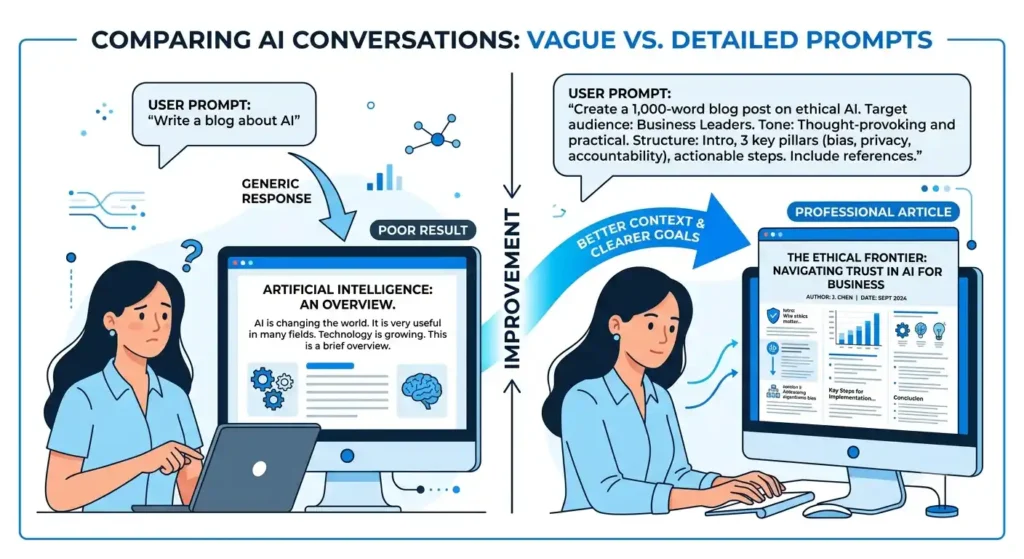
Picture this artificial intelligence as your knowledgeable assistant. But if you questions that are unclear about the objective Most probably will be getting general answers. But again when you ask the same question by providing some context goals examples The quality of answer improves automatically.
Basic Prompt
“Write a blog about AI”
Better prompt
“Write a 1500 word beginner friendly blog post explaining how AI helps small businesses save time. Use simple English, include- world examples, Faqs, and a friendly tone.”
Why prompt engineering is becoming so important
Nowadays AI is no longer limited to the technology companies. It has become day to day uses in the business world. The most common uses of AI in modern business is for:
- Writing articles
- Customer support
- Marketing campaigns
- Programming
- Data analysis
- Graphic design
- Research
- Education
- Healthcare
- Finance
- Human resource
Since AI is involving in everyday work, The ability to guide these tool effectively is becomes competitive advantage.
Knowing what to ask is often more valuable than simply knowing which AI tool to use.

The Ai Revolution has created a New Digital Skill
The AI revolution created a new skill almost overnight: knowing how to talk to a machine so it actually understands what you want. I’ve noticed most people still treat AI like a search engine, typing a few words and hoping for the best. That’s not how it works.
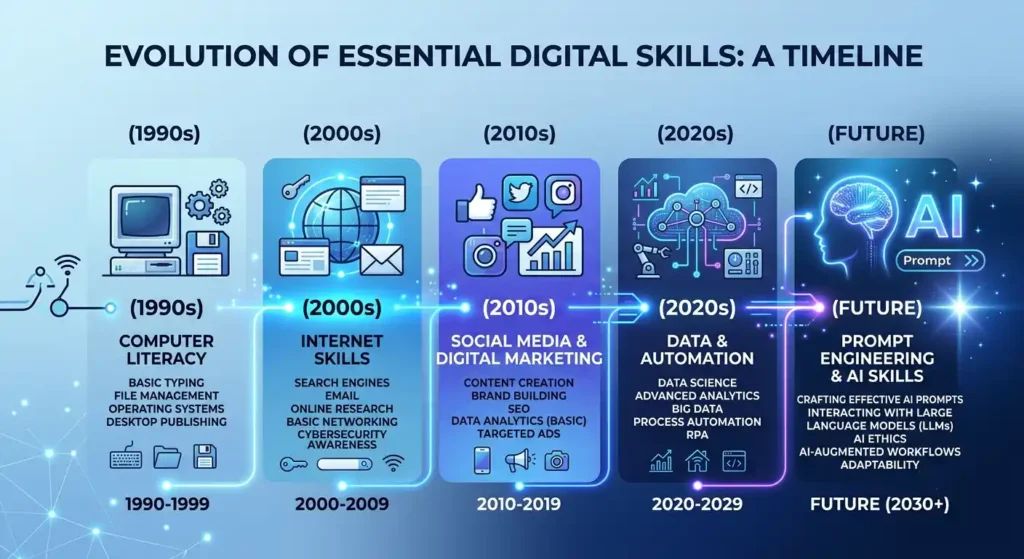
It’s more like giving directions to a cab driver, vague directions get you lost, but clear ones get you exactly where you’re going. This skill, often called prompting, just means being specific about your goal, your audience, and the format you want back. Get good at that, and it helps with every AI tool you touch, not just the one you started on.
Why Companies Value Prompt Engineering
Companies value prompt engineering because it’s the difference between an AI tool that wastes people’s time and one that actually saves it. I’ve noticed two people can use the exact same AI model and get totally different results, and the only gap between them is how well they ask for what they need. That’s not a small thing, that’s a skill companies pay for.
Think of it like hiring someone who’s great at giving instructions to a new employee: the clearer the instructions, the less time gets wasted redoing the work.
So when someone knows how to write a good prompt, like asking for “a 3-bullet summary of this report for a non-technical manager” instead of just “summarize this,” they get usable output on the first try. That saves hours across a whole company, and that’s exactly why the skill has become so valuable, not because it’s flashy, but because it just works.
Prompt Engineering Is Useful in Almost Every Career
Prompt engineering is useful in almost every career because every job now involves some version of “get the AI to do this well.” A teacher uses it to turn a textbook chapter into a quiz. A lawyer uses it to summarize a contract into plain language. A nurse uses it to turn shift notes into a clean handoff report. Different jobs, same skill underneath.
I’ve noticed the pattern is always the same: the person who tells the AI exactly what they need, who it’s for, and what format it should come in, gets something usable right away. The person who just types a vague request gets something they have to fix by hand.
It’s like knowing how to search a library well instead of just wandering the shelves, the skill isn’t the tool, it’s knowing how to ask it the right question. So no matter the career, prompt engineering just means asking clearly, and that pays off everywhere.

The Difference Between Good and Great Prompts
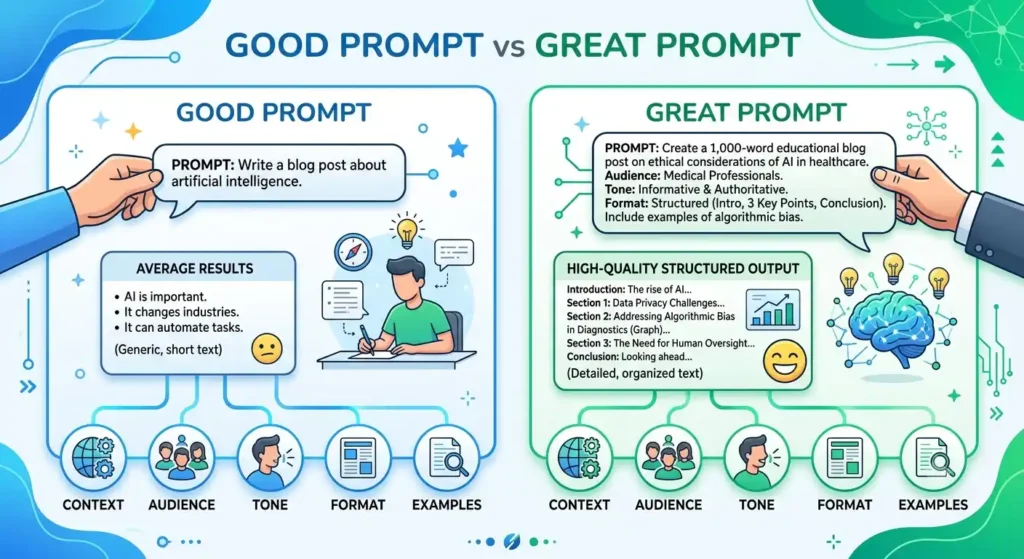
A good prompt gets you an answer. A great prompt gets you the answer you actually needed, on the first try.
“Write a product description” is good. “Write a 50-word product description for a running shoe, aimed at first-time marathon runners” is great. Same request, but one gives the AI a target to aim at.
I’ve noticed the gap comes down to three things: audience, format, and purpose. Skip those, and you end up rewriting the output yourself. Include them, and the first draft is often the final one.
It’s like ordering food: “I’ll have the chicken” is fine, but “chicken, medium spice, no onions” gets you what you actually want. That small habit is what separates a good prompt from a great one.
Common Mistakes Beginners Make
Most beginners make the same mistake: they type a vague request and expect a great answer back. “Write something about marketing” is a mistake. “Write a 100-word Instagram caption for a coffee shop’s new cold brew launch” is the fix. Same topic, but only one gives the AI something to work with.
I’ve noticed another common one is skipping the format. People forget to say if they want a list, a short paragraph, or a formal tone, so they end up with something they have to reshape by hand.
It’s a bit like asking a tailor for “a shirt” instead of giving your size and style, you’ll get something, just not something that fits. Fix these small gaps, and most of the frustration with AI tools disappears.
How Prompt Engineering Saves Time
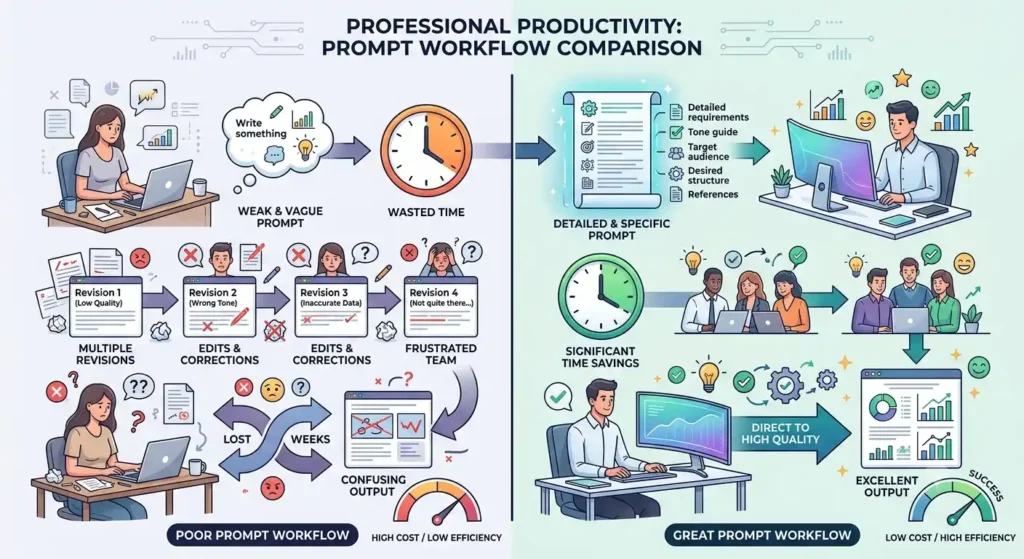
Prompt engineering saves time because it cuts out the back-and-forth of fixing a bad first draft. A vague prompt gets you an answer, but usually the wrong one, so you end up rewriting it yourself. A clear prompt, like “summarize this report in 3 bullet points for a busy manager,” gets you something usable right away.
I’ve noticed the real time loss isn’t in typing the prompt, it’s in all the small edits that come after a bad one. Skip those edits, and you get your time back.
It’s like giving clear directions before a trip instead of correcting the driver at every wrong turn. Get the prompt right the first time, and you save the time you’d have spent fixing it later.
Will Prompt Engineering Replace Traditional Skills?
Prompt engineering isn’t replacing traditional skills, it’s sitting on top of them. A doctor still needs medical knowledge, a lawyer still needs to understand the law. AI just becomes a faster way to use that knowledge, so the core skill stays, it just gets a new tool attached to it.
I’ve noticed the roles that vanish are the ones built entirely around repetitive tasks, not the ones built on judgment. AI can draft an email, but it can’t decide what the client actually needs to hear.
On pay, the range is wide. Entry-level prompt engineers earn around $60,000 to $85,000 a year, while mid-level roles average roughly $110,000 to $130,000. At top AI labs, senior specialists can clear $180,000 to $250,000 in base pay, with total packages (including equity and bonuses) sometimes topping $300,000.
So it’s less a replacement and more an upgrade, like a mechanic who now uses a diagnostic computer instead of just a wrench. The wrench skills still matter, they’re just paired with something new.
How to Start Learning Prompt Engineering
Starting with prompt engineering is simpler than people think, you don’t need a coding background, just a habit of being specific. Start by picking one small task, like writing an email or summarizing an article, and try giving the AI clear details: your goal, your audience, and the format you want back.
I’ve noticed the fastest way to learn is by comparing a vague prompt to a detailed one on the same task, you’ll see the difference in the output right away. Once you notice that gap, you start building the instinct without even trying.
It’s like learning to cook, you don’t start with a five-course meal, you start with one dish and get it right. So pick one prompt, make it specific, and build from there.
Essential Tips for Writing Better Prompts
Writing better prompts comes down to a few habits, not some big secret. Always give the AI three things: your goal, your audience, and the format you want back. “Write about fitness” is vague, “Write a 100-word Instagram caption about home workouts for busy parents” gives the AI something to actually aim at.
I’ve noticed examples help more than explanations, so if you want a specific tone or structure, show the AI a short example instead of just describing it.
It’s like giving someone a reference photo instead of describing a haircut, you’ll get closer to what you actually wanted. So keep it specific, show examples when you can, and treat every prompt like a small brief, not just a question.
The Future of Prompt Engineering
The future of prompt engineering probably isn’t a separate job title, it’s a skill that quietly folds into every other role. I’ve noticed this shift already happening, where “prompt engineer” postings are turning into “AI engineer” or “AI specialist” roles that just expect prompting as one skill among many, not the whole job.
That doesn’t mean the skill disappears, it means it gets built into how people already work, the same way “computer skills” stopped being a separate resume line once everyone needed them.
It’s like how knowing how to search the internet well used to be a standout skill, now it’s just assumed. So prompt engineering will likely go the same way, less of a specialty, more of a basic expectation for anyone working with AI.
Frequently Asked Questions
Is prompt engineering difficult to learn?
No. Anyone willing to practise can learn the fundamentals. Like writing or public speaking, it improves with consistent use.
Do I need coding knowledge?
Not at all. While developers use prompt engineering, marketers, writers, teachers, entrepreneurs, researchers, designers, and students benefit from it too.
Which AI tools should I learn?
Popular tools include ChatGPT, Claude, Gemini, Microsoft Copilot, GitHub Copilot (for developers), and image-generation tools such as Midjourney or Adobe Firefly. The core principles of writing effective prompts transfer across many AI systems.
Can prompt engineering improve my career?
Yes. Employers increasingly value people who can use AI responsibly to work more efficiently, solve problems, and produce high-quality results. Prompt engineering is one of the practical ways to build that capability.
Is prompt engineering only a temporary trend?
The tools will continue to evolve, but the underlying skill—communicating clearly with AI and evaluating its output—is likely to remain valuable as AI becomes more integrated into everyday work.

Final Thoughts
Prompt engineering comes down to one idea: AI is only as good as the instructions you give it. “Write about marketing” gets you something generic, but “write a 100-word Instagram caption for a coffee shop’s cold brew launch” gets you something usable right away. I’ve noticed the gap always comes from three things: goal, audience, and format.
It’s like giving directions to a cab driver, vague directions get you lost, clear ones get you exactly where you’re going. So this skill isn’t replacing what people already know, it’s sitting on top of it, the same way computer skills did years ago. Start small, get specific, and the rest builds on its own.
 TechPro Master
[…] what you had in mind. If you want the fuller picture of this skill beyond just this comparison, our Beginner guides to prompt engineering walks through it end to […]