
If you’re trying to figure out prompt engineering vs programming and which one you actually need to learn, you’re not alone. Ask five people what prompt engineering is and you’ll probably get five different answers. Some will tell you it’s just typing questions into ChatGPT. Others will swear it’s a real technical skill, close cousin to programming. So which is it, and if you already know how to code, does that even matter?
I’ve spent enough time bouncing between writing actual code and writing prompts to notice they pull on completely different muscles. They can look similar on the surface, both involve typing instructions into a computer and waiting for a result, but the way each one works underneath is pretty different. So let’s break down the real differences between prompt engineering vs programming, where they overlap, and whether you need to learn one before the other.
What Is Programming, Really?
Programming means writing instructions in a language a computer can execute exactly, step by step, with no room for guessing. You tell the computer: take this number, add five to it, check if it’s bigger than ten, then do this. Every line has one correct way to write it, and if you get a bracket or an indent wrong, the whole thing can break.
Think of programming like writing a recipe for someone who’s never cooked before and follows instructions completely literally. If the recipe just says “add a pinch of salt” without defining pinch, that cook is stuck. So you learn to spell everything out: exact amounts, exact order, exact timing.
That’s the real skill in programming: taking a fuzzy idea in your head and turning it into a sequence so precise that a machine with zero judgment can carry it out correctly every time. Keep this in mind as we get further into prompt engineering vs programming, since precision is the trait that separates the two. If you want a deeper technical breakdown of how instructions get executed, Wikipedia’s overview of computer programming is a solid starting point.
What Is Prompt Engineering, Really?
Prompt engineering means writing instructions in plain, everyday language to guide an AI model (a large language model, or LLM, like the one behind ChatGPT or Claude) toward the output you actually want. Instead of exact syntax, you’re working with words, tone, and examples, and the model fills in the gaps using patterns it learned during training. Anthropic’s own prompt engineering documentation is a good outside reference if you want to see how a major AI lab defines and teaches the skill.
Here’s the thing that trips people up: the model doesn’t execute your prompt the way a program executes code. It’s more like giving directions to a new employee who’s smart and well-read but has never met you and doesn’t know your preferences yet. You can hint, describe, and show examples, and a good employee picks up on all of it. But two different employees, or even the same one on two different days, might still interpret your instructions slightly differently.
That’s why prompt engineering is less about strict rules and more about a back-and-forth: you write a prompt, look at the result, and adjust your wording until the output matches what you had in mind. If you want the fuller picture of this skill beyond just this comparison, our Beginner guides to prompt engineering walks through it end to end.
Prompt Engineering vs Programming: 7 Key Differences
Here’s where prompt engineering vs programming really splits into two different skill sets. These are the seven differences that matter most.
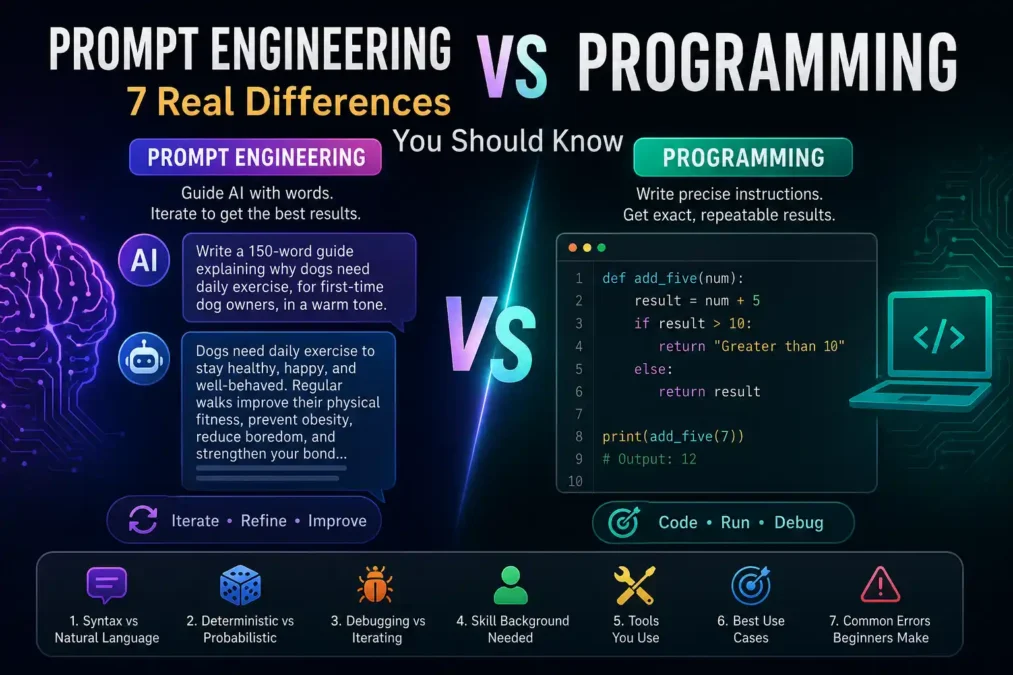
1. Syntax vs Natural Language
Programming has one correct grammar. Miss a bracket, misspell a function name, and the whole thing fails to run. Prompt engineering uses plain English, so there’s no strict grammar to break, just clarity to aim for.
2. Deterministic vs Probabilistic Results
Programming is deterministic, meaning the same input always produces the same output. Prompt engineering is probabilistic, meaning the model predicts the most likely good response based on your wording, and there’s no compiler checking your grammar before you hit enter.
Here’s a Bad Example vs Better Example pair that shows the gap:
Bad prompt: “Write something about dogs.”
Better prompt: “Write a 150-word beginner’s guide explaining why dogs need daily exercise, aimed at first-time dog owners, in a warm and encouraging tone.”
Notice the difference isn’t syntax, there’s no bracket to fix here. It’s specificity. In code, vague instructions just fail to compile. In a prompt, vague instructions still “work,” in the sense that you get an output, but it’ll be generic and probably not what you actually wanted.
3. Debugging vs Iterating
When code breaks, you trace the exact line that failed and fix it. When a prompt underperforms, there’s no error message to trace, you just rewrite the wording, add more context, and try again.
4. Skill Background Needed
Programming requires learning a language’s rules before you can build anything useful. Prompt engineering doesn’t, you can start writing decent prompts on day one with zero technical background.
5. Tools You Use
Programming happens in code editors, compilers, and version control systems built for precision. Prompt engineering happens in a chat window, and the only “tool” you really need is a willingness to rephrase.
6. Best Use Cases
Programming is built for tasks that need exact, repeatable results every time, like calculating a tax total or processing a payment. Prompt engineering is built for tasks that are flexible or creative, like drafting an email, summarizing a document, or brainstorming ideas.
7. How Errors Show Up
A programming error usually stops the program cold, loud and obvious. A prompt engineering “error” is quieter, the model still gives you an answer, it’s just the wrong one, generic or off-target instead of broken.
Do You Need to Learn to Code Before Prompt Engineering?
Short answer: no, you don’t. Prompt engineering doesn’t require you to know a programming language, and plenty of great prompt writers have never opened a code editor in their life.
That said, I’ve noticed that people with some coding background tend to pick up advanced prompting techniques a little faster, things like breaking a big task into smaller steps, or asking the model to “show its reasoning” before giving a final answer. That’s not because coding teaches you the “right” words to use. It’s because coding trains you to think in clear, ordered steps, and that habit transfers over well.
So if you’re a total beginner, don’t wait until you “learn to code” to start prompting. Start now, and treat every prompt like a small experiment: write it, check the result, tweak it, try again.
When to Use Each Approach
Neither one replaces the other, they’re just suited to different jobs. Here’s a quick way to decide between prompt engineering vs programming for whatever you’re working on:
- Reach for programming when you need exact, repeatable results every single time, like calculating a tax total or processing a payment.
- Reach for prompt engineering when the task is flexible or creative, like drafting an email, summarizing a document, or brainstorming ideas.
- Reach for both together when you’re building something like a customer support tool, where code handles the logic and structure, and a prompt handles the natural, human-sounding response.
- Lean on programming for anything safety-critical or high-stakes, where “usually correct” isn’t good enough.
- Lean on prompting when speed and adaptability matter more than perfect precision, like early prototyping.
Common Mistakes Beginners Make
Once you understand prompt engineering vs programming as two separate skill sets, it’s easier to spot where beginners usually trip up.
- Treating prompts like search queries. Typing three keywords and hoping for a detailed, tailored answer almost never works as well as describing what you actually want.
- Expecting code-like consistency. Two nearly identical prompts can produce noticeably different results, and that’s normal, not a bug you need to fix.
- Assuming one perfect prompt exists. Prompting is iterative. Your first attempt is a draft, not a final answer.
For a longer walkthrough of prompt-writing habits, including specific examples you can copy, our How to write better AI prompts guide goes deeper.
FAQ
What’s the main difference between prompt engineering vs programming? Programming uses exact, deterministic syntax that a computer executes the same way every time. Prompt engineering uses natural language to guide an AI model toward a probable, not guaranteed, result. That difference in predictability is the core of the prompt engineering vs programming debate.
Is prompt engineering a real job skill, or just a buzzword? It’s a real, practical skill, even if the exact job title “prompt engineer” has become less common as models have gotten better at understanding vague instructions on their own. The underlying skill, communicating clearly with an AI model, still matters a lot.
Will AI eventually replace the need for programming? Not likely anytime soon. AI models are great at generating code quickly, but someone still needs to understand what correct, secure, and reliable code looks like to check the output. Programming knowledge is what lets you catch the mistakes the model makes.
Can I use prompt engineering inside a coding project? Yes, and this is becoming really common. Developers write code that calls an AI model, and the prompt inside that code is what shapes the model’s response. So the two skills often work side by side rather than competing.
Conclusion
Programming and prompt engineering aren’t the same skill wearing different clothes, they’re genuinely different ways of getting a computer to do what you want. When you weigh prompt engineering vs programming, it really comes down to precision versus flexibility: programming gives you exact control through strict syntax, prompt engineering gives you speed through natural language, at the cost of some predictability.
You don’t need to master one before touching the other. Start small: pick a task you’d normally hand to a search engine, turn it into a clear, specific prompt, and see what comes back. Then tweak it and try again. That one habit, treating prompts as drafts instead of final answers, is the fastest way to actually get good at this.

 TechPro Master