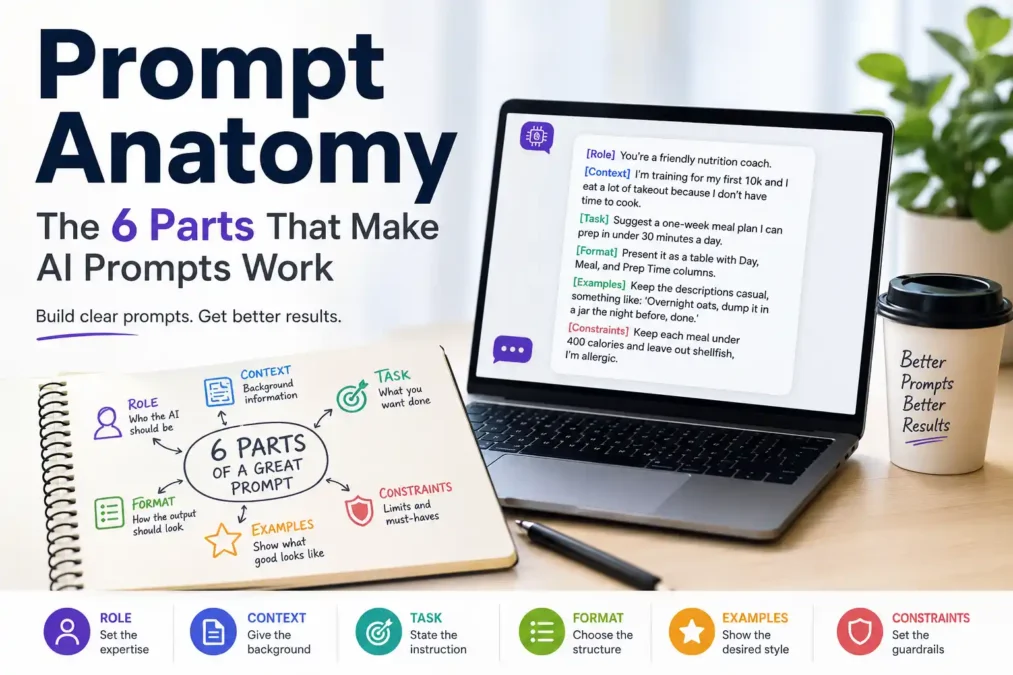

Prompt anatomy is why some AI prompts work and others fall flat. You ask for something simple, and it comes back mushy or just wrong, so you tweak a word and nothing changes. That’s rarely a bad AI, it’s a missing-parts problem. I’ve pulled apart enough of my own prompts to know the fix, and this guide breaks prompt anatomy down into six parts you can use on your very next prompt.
Why Do Vague Prompts Fall Apart?
When a prompt is missing a part, the AI doesn’t stop and ask what you meant, it just guesses. And guessing produces the most average, generic answer it can come up with, because average is the safest bet when the details aren’t there.
Think about giving directions to a cab driver: if you just say “take me to the mall,” you’ll probably end up somewhere, but maybe not the entrance you wanted, or even the right mall. Say “the north entrance of Westfield on 5th, I’ve got a stroller so avoid stairs,” and the driver knows exactly where to go and how. Prompts work the same way, and understanding prompt anatomy is what turns “take me to the mall” into directions an AI can actually follow. IBM’s rundown of the field covers the bigger picture if you want the enterprise-level version of this same idea.
The Anatomy of a Good AI Prompt: 6 Core Parts
Not every prompt needs all six parts of this anatomy every time, short questions don’t. But when a prompt keeps coming back wrong, it’s almost always missing one of these.
1. Role: Tell It Who to Be
The role tells the AI what expertise or point of view to answer from. It’s the fastest single change you can make to a prompt, because it resets the vocabulary, depth, and even the tone of the whole answer.
Bad: “Explain inflation.” Better: “You’re an economics teacher explaining inflation to a 10th grader who’s never taken an econ class.”
The first version could come back as a dense paragraph full of jargon. The second one almost has to come back simple, because you told it who’s listening.
2. Context: Give It the Background
Context is the information the AI needs but has no way of already knowing, like what already happened, who the audience is, or what’s at stake. Skip it and the AI solves a problem you didn’t actually ask about, confidently and in detail.
Bad: “Write a follow-up email.” Better: “Write a follow-up email to a client who went quiet after we sent a proposal two weeks ago. This is our third attempt to reach them.”
Notice how the better version changes the whole approach, a third follow-up should sound different from a first one.
3. Task: Say Exactly What You Want Done
The task is the actual instruction, the verb doing the work. Words like “help with” or “talk about” sound like instructions but leave way too much open.
Bad: “Help me with my resume.” Better: “Rewrite the bullet points under my Experience section so each one leads with a result or number instead of a duty.”
A specific verb plus a specific target cuts out most of the guessing right there.
4. Format: Tell It How to Hand Back the Answer
Format is the shape you want the output in, a list, a table, a certain length, plain text instead of code. Leave it out and you’ll often get a wall of text when what you needed was five bullet points.
Bad: “Give me ideas for a birthday party.” Better: “Give me 5 birthday party ideas as a bulleted list, each with a one-sentence description.”
Format decides whether you get a wall of text or something you can actually use right away.
5. Examples: Show It What Good Looks Like
This is sometimes called “few-shot prompting” (see Google Cloud’s explainer if you want the technical definition), which is just a fancy way of saying you show the AI a sample of what you want instead of describing it in the abstract. In prompt anatomy terms, this is the part that does the most convincing. I find myself reaching for this one the most, because describing a “fun tone” means something different to everyone, but one good example pins it down fast.
Bad: “Write product descriptions in a fun tone.” Better: “Write product descriptions in this style: ‘This blender doesn’t just mix smoothies, it holds grudges against lumps.’ Match that voice for the next 5 products.”
One solid example locks in the voice faster than three sentences describing it ever could.
6. Constraints: Set the Guardrails
Constraints are your limits, things like length, tone to avoid, or details that must not show up in the answer. This is the part people forget most, and it’s the one that causes the most rewrites afterward.
Bad: “Write a LinkedIn post about my promotion.” Better: “Write a LinkedIn post about my promotion, under 100 words, no exclamation marks, and don’t mention my previous employer by name.”
Setting the limits up front saves you a rewrite later.
Prompt Anatomy in Action: Stitching the Parts Into One Prompt
Here’s what prompt anatomy looks like when all six parts work together in one prompt, each one labeled so you can see the seams:
“[Role] You’re a friendly nutrition coach. [Context] I’m training for my first 10k and I currently eat a lot of takeout because I don’t have time to cook. [Task] Suggest a one-week meal plan I can prep in under 30 minutes a day. [Format] Present it as a table with Day, Meal, and Prep Time columns. [Examples] Keep the descriptions casual, something like: ‘Overnight oats, dump it in a jar the night before, done.’ [Constraints] Keep each meal under 400 calories and leave out shellfish, I’m allergic.”
You wouldn’t actually type the bracket labels into the AI, they’re just there so you can see which sentence is doing which job. Once you can spot the six parts inside someone else’s prompt, writing your own gets a lot faster.
Common Mistakes People Make With Prompt Anatomy
Most prompt anatomy mistakes come down to skipping a part, not getting one wrong. Here’s what that looks like in practice:
- Skipping context and expecting the AI to read your mind. The AI doesn’t know what happened before you opened the chat, so tell it.
- Cramming every part into one run-on sentence. Splitting the parts across separate sentences, or even labeling them like the example above, makes it easier for both you and the AI to track what’s covered.
- Using vague verbs like “help with” or “talk about.” These sound like instructions but don’t actually instruct anything. For more habits like this one, 8 habits that are quietly wrecking your results covers a longer list.
- Adding format and constraints as an afterthought. If you only mention the word limit after getting three paragraphs back, you’ve already wasted a round trip. Put format and constraints in the first prompt, not the follow-up.
- Reusing the same prompt for a different task and wondering why it flopped. A prompt built for one role, context, and task doesn’t automatically transfer, check all six parts still fit before you reuse it.
Common Questions About Prompt Anatomy
Do I need all 6 parts every time? No. Quick, simple questions don’t need a role or constraints. Save the full six-part structure for prompts where the output actually matters, a work email, a report outline, anything you’d be annoyed to redo.
What if I don’t know what format I want? Ask the AI. Add a line like “ask me what format would work best before you answer,” and let it prompt you back.
Is prompt anatomy the same thing as prompt engineering? Prompt anatomy is really just the beginner layer of prompt engineering, the part you can learn in one sitting. If you want pre-built structures instead of writing every part from scratch, prompt templates for beginners walks through ready-made ones you can copy and adjust.
How long should a good prompt be? As long as it takes to cover the parts that matter, and not a word longer. A two-sentence prompt with a clear role, task, and format usually beats a rambling paragraph that’s missing all three.
Wrapping Up on Prompt Anatomy
A prompt that keeps falling flat almost always has a missing part, not a broken idea. Go back through the six pieces of prompt anatomy, role, context, task, format, examples, constraints, and figure out which one you skipped. Once you can spot the gap, fixing it takes seconds. Start small: pick one prompt you’re not happy with today, add the one part it’s missing, and see what changes. If you want the short version of this whole idea, the zero-experience prompt hack is a faster way in.
 TechPro Master
[…] wrong. If you want the fundamentals of prompt writing in general before narrowing in on images, the six-part structure behind every good AI prompt is a good place to […]